Fourteen islands sit in the Fažana Strait, 2 km off the coast of Istria just north of Pula, and 78% of Brijuni National Park is water. Of its 3,395 hectares, only 743 are land. Just one island, Veliki Brijun, takes regular visitors; the rest you see from a boat or not at all. A single timed ticket covers the 15-minute crossing, a guided circuit by tourist train, the safari park and the museums — about four hours end to end.
What you're actually buying is three eras stacked on one flat, green island: Roman villa complexes from the 1st century BC, a Habsburg-era health resort built by Viennese industrialist Paul Kupelwieser, and Josip Broz Tito's summer capital, where 90 meetings with leaders of 60 states took place and the 1956 Brijuni Declaration laid the groundwork for the Non-Aligned Movement. You can read the full backstory in our guide to the park's history — here's what to do once you're on the island.
What Makes Brijuni National Park Different (and How a Visit Works)
You cannot drive to Brijuni, and no private ferry competes for your money. The park's own boat from Fažana is the only public way in, cars are never transported, and everything on shore is bundled into one timed ticket. That makes planning simpler than it looks — and much less forgiving if you arrive late.
The island you land on carries three distinct layers. Romans farmed and built here from the 1st century BC, leaving villas, temples and mosaics around the bays. In 1893 Kupelwieser bought a malarial archipelago and, with Nobel-winning bacteriologist Robert Koch and forester Alojz Čufar, turned it into a fashionable resort; malaria was declared eradicated in 1901. After 1945 the islands became Tito's state summer residence, and the safari animals, clipped meadows and museum exhibitions largely date from that stretch.
There are two ways to visit. The standard guided excursion runs about four hours: return boat, licensed guide, a one-hour tourist-train circuit, the safari park, Verige Bay and the museum displays. The alternative is the self-guided ticket with the Brijuni Pocket Guide app (€40 in summer, €30 otherwise), which includes the same boat but leaves the exploring to you, on foot or by rental bike. First-timers and families should take the excursion; independent travellers planning a full day will get more from the app.
Be honest with yourself about what this park is. Around 200,000 people a year visit for history, free-roaming animals and quiet lanes. If you're after waterfalls or alpine drama, Plitvice and Krka do it better — and cheaper.
The Safari Park and Brijuni's Animals: Lanka, Koki and the Pheasantry
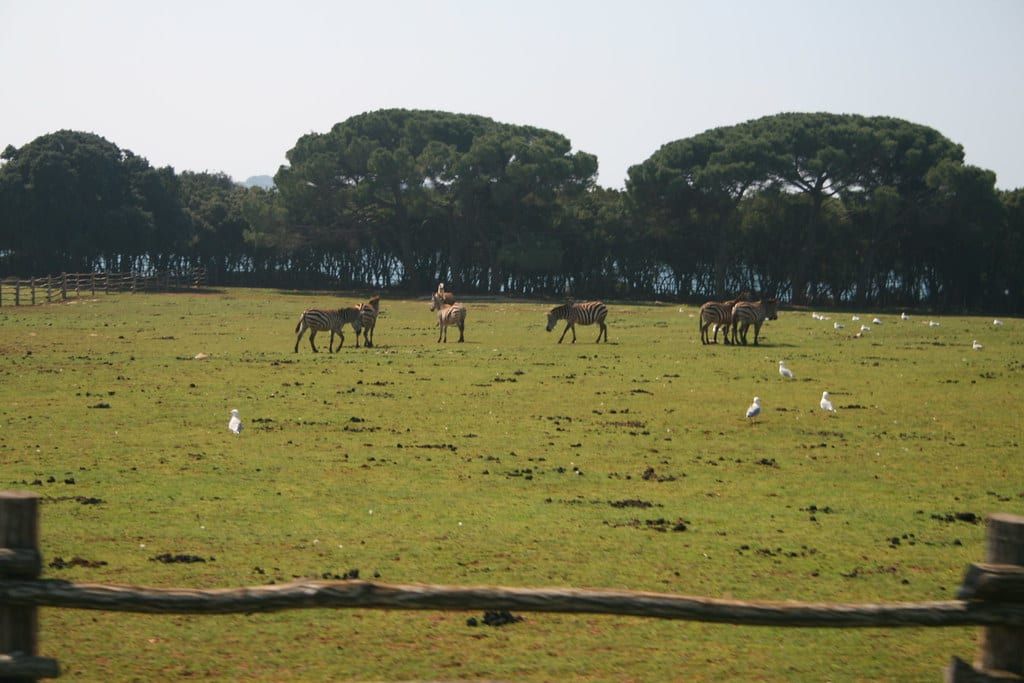
Nine hectares of meadow at the northern tip of Veliki Brijun hold about 80 herbivores, and nearly every one of them arrived as a diplomatic gift to Tito. It's the park's single most-loved attraction, and the reason children usually leave happy. We cover the full story in our guide to the safari park.
A Cold War gift catalogue
Lanka, the Indian elephant, came from Indira Gandhi in 1972. The zebras arrived from Sékou Touré of Guinea in 1960–61, and the zebu was Nehru's gift in 1959. Walking the fenced perimeter, you're essentially reading a guest list of the Non-Aligned world — every animal a receipt from a state visit.
What roams free outside the fences
Fallow deer, axis deer and mouflon were introduced as game animals in the early 20th century and now graze across the whole island, along with hares and peacocks that strut through the Roman ruins near the harbour. Birdwatchers regularly spot little egrets, squacco herons and European shags, and injured sea turtles convalesce here in season.
Then there's Koki, the yellow-crested cockatoo Tito gave his granddaughter for her ninth birthday. He's around 70 now, still talks, and will shake your hand — the species can live a century. Near him, the old pheasantry has run as a wildlife rescue centre for animals, birds and reptiles since 2017.
One practical note: the tourist train stops roughly ten minutes inside the safari park, which is barely enough for photos. If you're staying the day, walk back up in the afternoon when the tour groups have moved on.
Roman and Byzantine Brijuni: Verige Bay, the Castrum and the Quarry Walk
Brijuni's ruins are the reason the island was protected in the first place, and they're compact enough to see all of them in a day. Two sites matter, and one odd memorial.
The Roman villa in Verige Bay
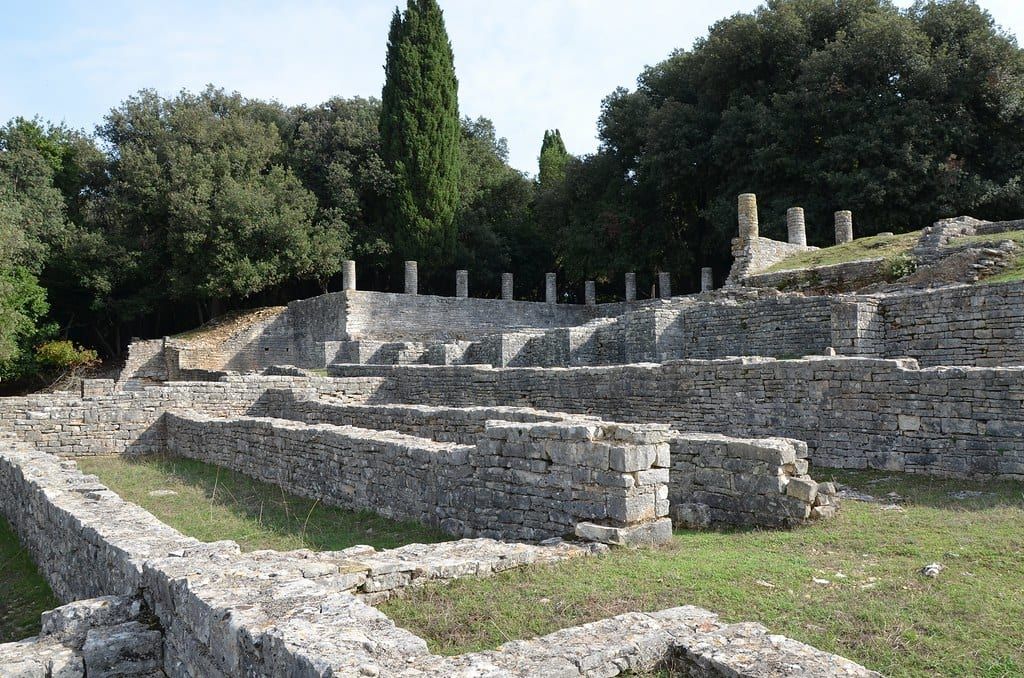
A 1st-century-BC villa rustica wrapped around Verige Bay, on the island's eastern shore, with temples to Neptune, the Capitoline Triad and Venus, all decorated with mosaics, frescoes and marble. Around a kilometre of connected buildings once stood here — a working farm and a luxury retreat in one. The tourist train stops at the site, and the guided snorkel trail (below) shows you its submerged side.
The Byzantine castrum at Dobrika Bay
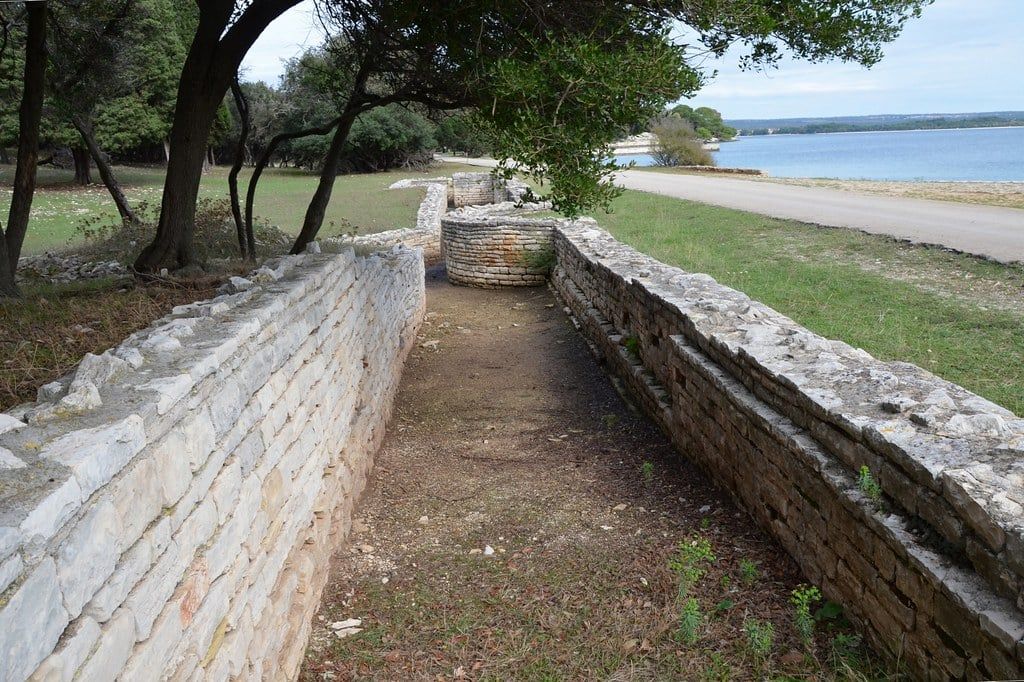
On the opposite coast, the castrum grew from a 1st-century-BC villa into a walled settlement whose defences date to the mid-5th century. Beside it stands the Basilica of St Mary, unusual for its rectangular apse, and the Church of St Peter with a tricoloured mosaic floor. Deer often graze among the stones — keep to the paths and don't climb the monuments, which are unfenced but protected.
Quarries, St German's church and the Koch memorial
The islands were quarried under Venetian rule from 1331, and the old quarries are now shaded promenades. One of them memorialises Robert Koch, who won the Nobel Prize in 1905 and helped eradicate malaria here in the early 1900s — the reason a luxury resort could exist on these islands at all. Close to the harbour, the Church of St German holds a rare danse macabre fresco and inscriptions in Glagolitic script, the medieval Croatian alphabet.
Dinosaur Footprints: The 130-Million-Year-Old Trail
More than 200 dinosaur footprints, left between 130 and 100 million years ago, survive at four sites in the park. Two of them you can walk to; the rest are boat-only. It's the island's most surprising sight and reliably the one kids recount on the ferry home.
Cape Ploče and Cape Vrbanj
The reachable sites are Cape Ploče and Cape Vrbanj, both on Veliki Brijun's shoreline — a 20-minute bike ride from the harbour, and the main reason to rent wheels for the afternoon. At Cape Vrbanj a life-size theropod reconstruction stands beside the prints, which gives you the scale: these were serious predators.
The print everyone walks past
At the entrance to the harbour, a three-toed theropod footprint is set in a limestone block. Most visitors stroll straight by it on their way from the boat. Pair it with the small dinosaur exhibit near the harbour before you head out to the capes, so you know what you're looking at.
The remaining sites — on the islets of Vanga, Galija and Vrsar — are visible only from the water, on Brijuni boat tours that circuit the archipelago.
The Mediterranean Garden and the 1,600-Year-Old Olive Tree
Two quiet stops, five minutes' stroll apart, that most visitors on the four-hour excursion never reach. Both sit on the train-tour route, so self-guided visitors have no excuse.
The Mediterranean Garden
Established in 2007 on the site of a former forest nursery, the garden covers 17,000 m² and holds 169 native and exotic species, each labelled with a QR code. Lavender, rosemary and holm oak in clipped rows — it's a calm half-hour, and the shade is welcome in July.
The 1,600-year-old olive tree
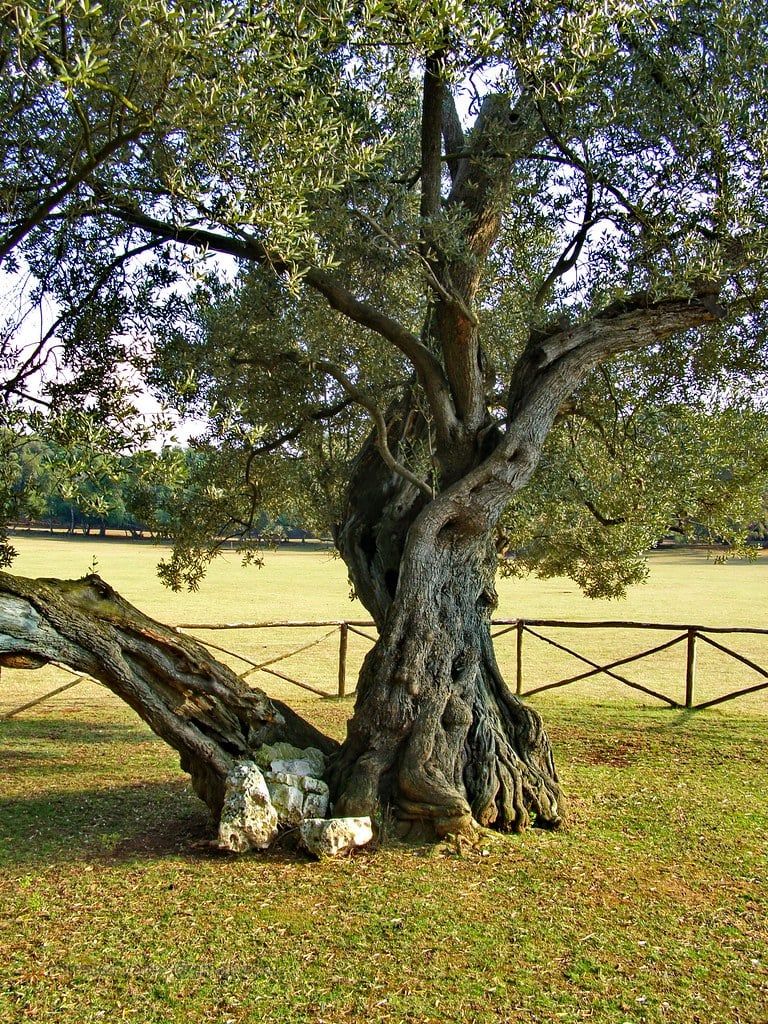
Carbon-dated by Zagreb's Ruđer Bošković Institute, the old olive is about 1,600 years old — older than every ruin on the island. A storm in the 1970s split the trunk, and the concrete patch holding it together is still visible. It keeps fruiting: roughly 30 kg of olives a year, pressed into about 4 kg of extra-virgin oil.
Tito's Brijuni and the Island Museums
Tito first came to Brijuni in 1947 and used the White Villa as his official residence from 1953 until 1979, spending much of the year on the island. The Cold War layer is what separates Brijuni from every other Croatian park — but you need to know where to look, because the villa itself is closed.
The White Villa and the Brijuni Declaration
The park records 90 meetings between Tito and presidents, kings and tsars of 60 states. The 1956 meeting with Nasser and Nehru produced the Brijuni Declaration, the groundwork of the Non-Aligned Movement. You can't enter the White Villa — it's still used for official functions — so the photo exhibitions in the safari-park building carry the story instead, with images of state visits, safaris and the guest register.
The 1953 Cadillac
Tito's dark-green 1953 Cadillac, a gift from Croatian immigrants in Canada, shows just 18,000 miles on the clock. It carried Nehru, Indira Gandhi and Haile Selassie around the island, and you can still ride in it: it's rentable with a driver, reported at around €1,400 an hour. For most people, looking is enough.
The Boathouse
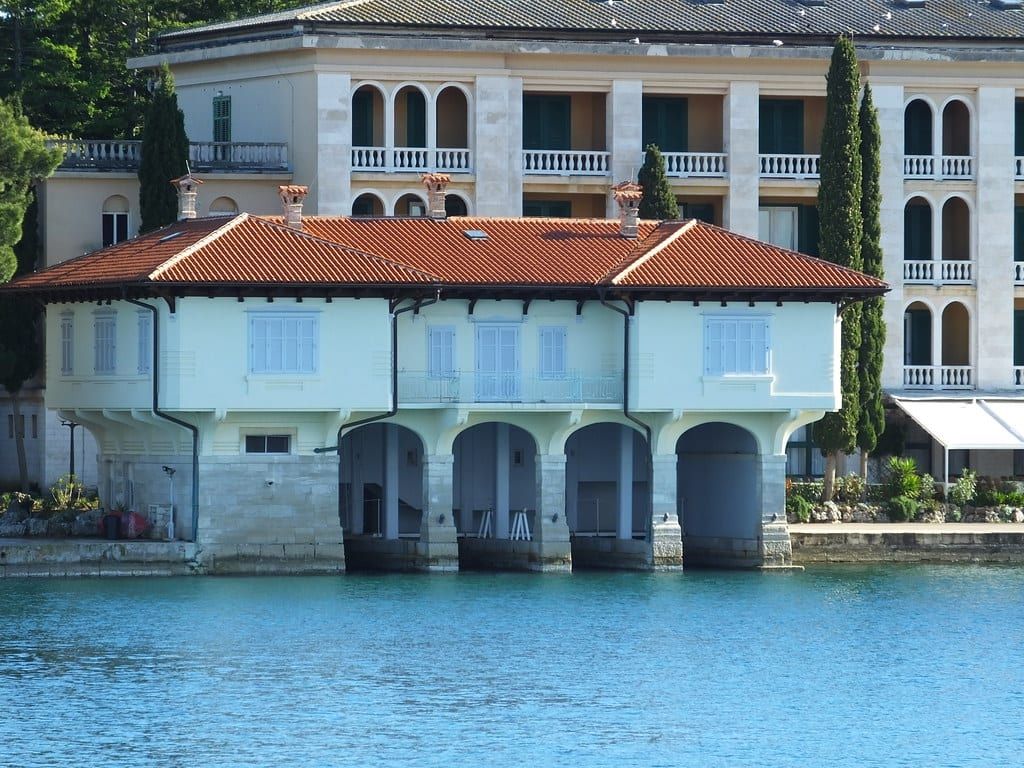
Built in 1902 in the Austro-Hungarian Secession style as the home of island doctor Otto Lenz, the Boathouse is now the park's Interpretation and Education Centre, with six interactive units covering the islands' natural history. It's the best indoor stop on a rainy stretch, and it doubles as a reminder that Kupelwieser's resort — not Tito — built the modern island.
Getting Around: Tourist Train, Bikes, Golf Carts and Golf
Veliki Brijun is flat — the highest point, Vela Straža, is 55 m — but the circuit between the harbour, the safari park and the capes is long enough that transport matters. Three options, very different prices.
The tourist train
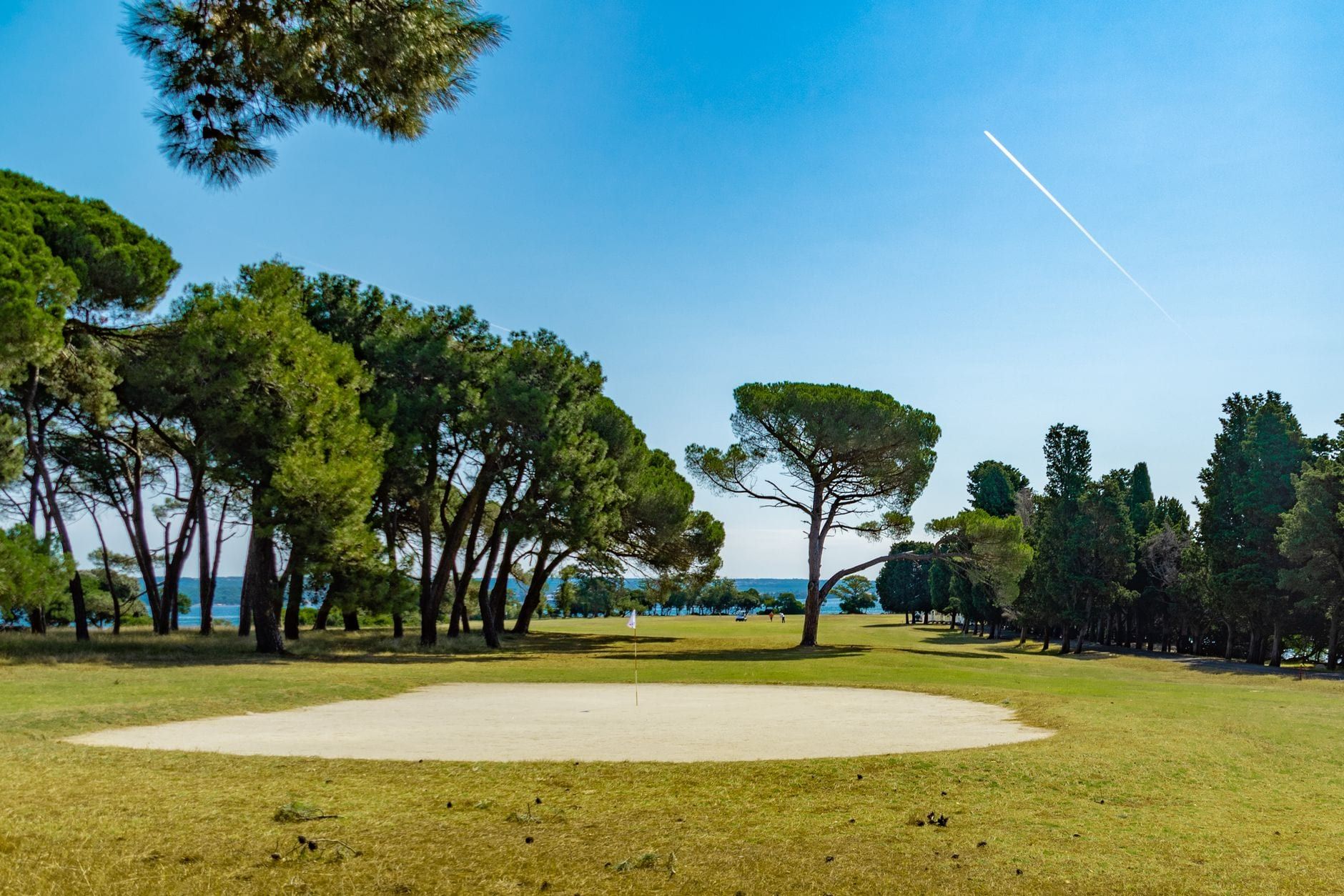
The roughly one-hour train loop is part of the guided excursion, running north past the golf course to the safari park and back along the west coast with a stop at Verige Bay. It's convenient, and in summer it's crowded — you'll share every view with a full carriage. It's transport, not a treat.
Bikes and golf carts
Bike rental runs around €7 an hour, and it's the best money you'll spend on the island — the west-coast lanes between pines and deer are what the train rushes past. The park keeps about 300 bikes and admits that's sometimes not enough in high season, so rent on the first boat. Electric golf carts cost around €30 an hour and require a driving licence. Bringing your own bike needs at least 24 hours' notice plus a fee, and boat capacity for bikes is limited — renting on the island is simpler.
Golf, tennis and diving
Golf has been played here since 1922, and the 18-hole course is playable practically year-round thanks to the island's mild microclimate. A day pass runs about €50 plus club rental. Tennis courts and scuba diving with local schools round out the sports options — though at these prices, most day visitors stick to the train, the bike and the beach.
Swimming, Snorkeling and the Islands Beyond Veliki Brijun
The water rules here are strict, and they trip up visitors who assumed a national park that's 78% sea would be swim-anywhere. It isn't. Learn the three allowed spots and the one exception, then decide how much of the rest of the archipelago you want.
Where you can swim
Swimming is limited to three designated places: Saluga Bay, with deck chairs, catering and a family-friendly shallow zone; Cape Slavulja; and the rocky beach near Villa Fažanka. Outside those zones, swimwear itself is against the park's dress code — you cannot board the boat, walk the promenades or enter restaurants in a swimsuit, so pack a cover-up.
The Verige Bay snorkel trail
Swimming is banned in Verige Bay to protect its wildlife — with one exception: the booked, guided underwater snorkel trail that runs the length of the bay's north side, past the submerged remains of the Roman villa. It's the only legal way to swim with the ruins, and our Brijuni snorkeling guide covers how to book it.
Mali Brijun, St Jerolim and Vanga
Mali Brijun holds a five-storey Austro-Hungarian fort, built 1895–1900, and is reached by the park's official Adventure Kayak Excursion along the protected coast; a stand-up paddleboard crossing takes about 20 minutes. St Jerolim is the swim-and-dive day-trip island — on panorama boats the entry fee is about €7 for adults — and it's going plastic-free: you get a trash bag with your ticket and carry your waste home, because the bins are being removed. Vanga, Tito's private island, stays closed to the public; officials still use it.
For lunch, Bistro Plaza sits on the water near the beach, or bring a picnic from Fažana and eat under the pines at Saluga. If you're weighing a full circuit of the islands, our Brijuni boat trip guide compares the options.
One Perfect Day in Brijuni National Park
Take the earliest boat — 09:00 in high season — for two reasons: you'll tour the safari park and Verige Bay before the crowds thicken, and you'll be first in line at the bike desk. A full afternoon on the island is what separates a good visit from a rushed one.
The morning belongs to the guided excursion, about four hours from boarding: the tourist-train circuit, the safari park, the stop at the Roman villa in Verige Bay, then the exhibitions near the harbour. By early afternoon you're back at the quay with the island's geography already in your head.
Lunch is a picnic at Saluga Bay under the pines, or the patio at Bistro Plaza. Then rent a bike and make the loop you couldn't on the tour: Cape Ploče and Cape Vrbanj for the dinosaur footprints, the Mediterranean garden, the old olive tree, and a swim slot at one of the three designated beaches. Check the last return boat before you set off — in the November-to-March schedule it leaves at 16:00, which ends the day abruptly.
How much time does Brijuni need? One full day is the minimum for Veliki Brijun. On foot, plan two days; by bike, one is enough.
In July and August you can stretch the day into the evening: a €15 ticket lets you land on the 18:00, 19:00 or 20:00 boats and stay as late as 23:00. The museums won't be open — the island information point shuts at 19:15 — but the day crowds are gone and the light is at its best. The Ulysses Theatre, founded in 2001 by actor Rade Šerbedžija and playwright Borislav Vujčić, stages open-air plays and concerts inside an Austro-Hungarian fort, and the Pula Film Festival brings its 'Cinema under the stars' to the island for summer film nights.
Planning Your Visit: Tickets, Ferries and Rules
Prices are season-split, and the gap is large enough to change your travel dates. The park's current hours and fees page is the place to confirm before you book, but the standing tariff looks like this:
| Ticket | June–September | October–May |
|---|---|---|
| Guided excursion, adult | €50 | €35 |
| Guided excursion, students & 65+ | €40 | €30 |
| Guided excursion, children 7–18 | €20 | €15 |
| Children under 7 | Free | Free |
| Self-guided app ticket, adult | €40 | €30 |
| Evening entry (July–August) | €15 | — |
The price includes the return boat from Fažana, the guide, the tourist train, the safari park, the museum displays, insurance and VAT. Hotel guests on the island get 20% off, and group discounts start at 25 people. Which format suits you comes down to pace and independence:
| Guided excursion | Self-guided app ticket | |
|---|---|---|
| Adult price | €50 summer / €35 Oct–May | €40 summer / €30 Oct–May |
| Format | Tourist train, licensed guide, fixed itinerary | Brijuni Pocket Guide app, on foot or by rental bike |
| Duration | About 4 hours, set departure | Your own schedule, any sailing |
| Best for | First visits, families, one-day visitors | Independent travellers, dog owners, all-day stays |
The rule that catches people out: your ticket carries a fixed departure time, and the crew will not board you earlier or later than that hour. Miss it and there's no refund and no rebooking. In summer, language slots on the guided excursion — Croatian, English, German, Italian, Russian — sell out before the boats do, so book at shop.np-brijuni.hr ahead of time. Reduced tickets for students, over-65s and visitors with a disability aren't sold online at all: email [email protected] and collect them at the park office at Brionska 10 in Fažana, 30 minutes before departure.
Boats run daily except in January and February, when the park admits groups only, on request. June to August gets twelve sailings a day, 09:00 to 22:00, with returns until 23:00; April, May, September and October drop the 20:00 boat; November to March runs just two sailings, at 09:00 and 11:30, with the last boat back at 16:00.
Getting to Fažana is the other half of the logistics. It's 8 km from Pula, and Pulapromet's suburban bus line 21 covers it in 15–21 minutes for €2.20 — but departures are irregular, with gaps of several hours mid-morning, so check the timetable before relying on it. Pula Airport is 15 km away. Driving from Rovinj takes about 35 minutes. Full transport detail is in our guide to getting to Fažana, and if you'd rather skip the planning entirely, day tours from Pula handle the boat and the timing for you. In August, add an hour to whatever the map says: the coast road clogs and parking near the quay is scarce — the €12-a-day Boraca 9 lot belongs to the park's hotels, not day visitors.
Best time to go: April to October, with May–June and September–October giving you swim-worthy sea, thinner crowds and — from 1 October — the €35 ticket. Stay either in the island's hotels or base yourself in Pula or Fažana; Fažana's waterfront is pleasant for an hour either side of your sailing.
Rules worth knowing before you land: dogs cost €15, must stay leashed, and are barred from the tourist train, the museums and the safari park. Taking natural items — including peacock feathers — off the island is prohibited. Shops are limited and there's no reliable ATM, so bring water, snacks and cash needs with you. And the dress code applies everywhere outside the designated beaches.
Is it worth it? The €50 summer fare is the steepest standard admission of any Croatian national park — above Plitvice's peak rate — and a family of four should budget roughly €140 for the day. The counterweight: no other park in the country packs Roman ruins, a safari park, dinosaur footprints and Cold War history into a single visit. For history-minded travellers, that trade is easy. If what you really want is a beach day, take the boat to St Jerolim instead — it costs about €7.
Frequently asked questions
How much time do you need in Brijuni National Park?
At least one full day for Veliki Brijun. The standard guided excursion runs about four hours end to end, while self-guided visitors with a rental bike or electric car commonly stay five to eight hours. On foot, plan two days; by bike, one is enough.
How much do Brijuni National Park tickets cost and what's included?
Adults pay €50 for the guided excursion from June to September and €35 from October to May; students and over-65s pay €40/€30, children 7–18 pay €20/€15, and under-7s go free. The self-guided app ticket is €40/€30. One price covers the return boat from Fažana, the guide, the tourist train, the safari park and the museum displays, with insurance and VAT included. Hotel guests get 20% off.
Do you need to book Brijuni tickets in advance?
Yes, in high season — language slots on the guided excursion sell out before the boats do. Every ticket carries a fixed departure time with no refund or rebooking, so buy at shop.np-brijuni.hr ahead of your visit. Reduced tickets (students, over-65s, visitors with a disability) are email-only at [email protected] and must be collected at the Fažana office 30 minutes before departure.
Is Brijuni National Park worth visiting?
If you want waterfalls or alpine drama, Plitvice and Krka do it better and cheaper. But no other Croatian park puts Roman ruins, a safari park, dinosaur footprints and Cold War history into one four-hour visit. The honest counterweight: €50 peak admission is the country's steepest, and the guided format is set-piece rather than freewheeling.
Can you swim in Brijuni National Park?
Only in three designated places: Saluga Bay (with deck chairs and catering), Cape Slavulja, and the rocky beach near Villa Fažanka. Verige Bay is closed to swimming to protect its wildlife, except for visitors booked on the guided underwater snorkel trail. Swimwear is not permitted outside the beach zones.
How do you get to Brijuni National Park from Pula?
Pulapromet suburban bus line 21 runs the 8 km to Fažana in about 15–21 minutes for €2.20, but departures are irregular, so check the timetable first. By car or taxi it's roughly 15 minutes. From Fažana quay, the park boat crosses to Veliki Brijun in 15 minutes.
When is the best time to visit Brijuni National Park?
April to October. May–June and September–October combine a warm sea with thinner crowds, and from 1 October the adult ticket drops from €50 to €35. July and August bring the full boat schedule, swimming weather and the evening programme, plus the year's biggest crowds. January and February are closed to individual visitors — groups only, by arrangement.
Can you bring a dog or your own bike to Brijuni?
Dogs travel for €15, must stay leashed, and are barred from the tourist train, the museums and the safari park — so the self-guided ticket suits dog owners best. You can bring your own bike with at least 24 hours' advance notice and a fee, but boat capacity for bikes is limited; renting on the island is easier.